
The Breath Ledger of the Bonus Line: India 42–21 Bangladesh at the Asian Games, and the Real Test on 23 September
মূল উত্তর: ২০২৬ এশিয়ান Gamesের মহিলা কাবাডি গ্রুপ এ-র উদ্বোধনী ম্যাচে ভারত বাংলাদেশকে ৪২–২১-এ হারিয়েছে। ভারতের ৪২ পয়েন্টের ১১টি বোনাস লাইন থেকে এবং ৪টি অল-আউট থেকে এসেছে। ভারতের পরের ম্যাচ ইরানের বিরুদ্ধে ২৩ সেপ্টেম্বর সকাল ৮:৩০-এ। মূল তথ্য: - ভারত ৪২–২১ বাংলাদেশ; বিরতিতে স্কোর ছিল ২১–১০, গ্রুপ এ-র প্রথম ম্যাচ। - ভারতের ১১ বোনাস পয়েন্ট মোট স্কোরের প্রায় ছাব্বিশ শতাংশ। - দুটি অল আউট থেকে ভারত ৪ পয়েন্ট পায়; বাংলাদেশ একটি সুপার ট্যাকলে ২ পয়েন্ট। - সঞ্জু দেবী ভারতের আক্রমণের নেতৃত্ব দেন, বাঁ কভারে মানিশা কুমারী কার্যকর ছিলেন। - বাংলাদেশের স্কোরবোর্ড টিকিয়ে রাখেন অধিনায়ক স্রাবনী মলিক। সূত্র: Khel Now-এর ম্যাচ রিপোর্ট, ২০২৬ এশিয়ান Games মহিলা কাবাডি, গ্রুপ এ (প্রকাশের তারিখ উৎসে স্পষ্ট নয়)। সম্ভাব্য Next প্রশ্ন: প্রশ্ন: ভারতের পরের প্রতিপক্ষ কে এবং কখন? উত্তর: ইরান, ২৩ সেপ্টেম্বর সকাল ৮:৩০-এ গ্রুপ এ-র ম্যাচ। প্রশ্ন: ভারতের আক্রমণ কি একজনের ওপর নির্ভরশীল? উত্তর: না, সঞ্জু দেবী, সোনালী শিনগাতে, পুষ্পা রানা ও পূজা — অন্তত চারজন রেইডার পয়েন্ট যোগ করেছেন। প্রশ্ন: বাংলাদেশের প্রধান কাঠামোগত দুর্বলতা কী? উত্তর: আক্রমণ প্রায় পুরোটাই অধিনায়ক স্রাবনী মলিকের ওপর নির্ভরশীল। প্রশ্ন: এই ম্যাচের সবচেয়ে বড় সতর্কবার্তা কোনটি? উত্তর: শেষ পাঁচ মিনিটে ব্যবধান সংকুচিত হওয়া, যা ইরানের বিরুদ্ধে ব্যয়বহুল হতে পারে।
The half-time whistle left the board reading 21–10. The final whistle left it at 42–21. Between those two numbers sat a third one, the kind the scoreboard never lights up separately: 11. In India's Group A opener of the women's kabaddi competition at the 2026 Asian Games, eleven of their forty-two points came off the bonus line.
The bonus line is a stripe painted deep in enemy territory. The rule: cross it while six or more defenders are on court and you take one point. Simple on paper. To the raider standing on the mat, it is not a scoring zone but a lung test. Entering a packed six- or seven-man defence costs extra steps, two or three changes of body axis, blows absorbed across shoulder and knee — and every extra second requires the throat to keep producing the chant that proves you are not inhaling.
As a child I thought this was a pursuit game played on clay. Now I read it as physics with a crowd, and as an accounting of breath. That accounting is what will decide India's gold defence on 23 September, against Iran.
The setting: court, rules, competition structure
Kabaddi reaches very few countries, which makes the Asian Games its largest stage. Men's kabaddi has been a medal sport since 2026; the women's event arrived in 2026. This tournament uses Standard Style — rectangular court, seven against seven, two twenty-minute halves. The circular-court version played in Bangladeshi and Pakistani villages follows different rules entirely; read a scoreline without that distinction and the arithmetic collapses.
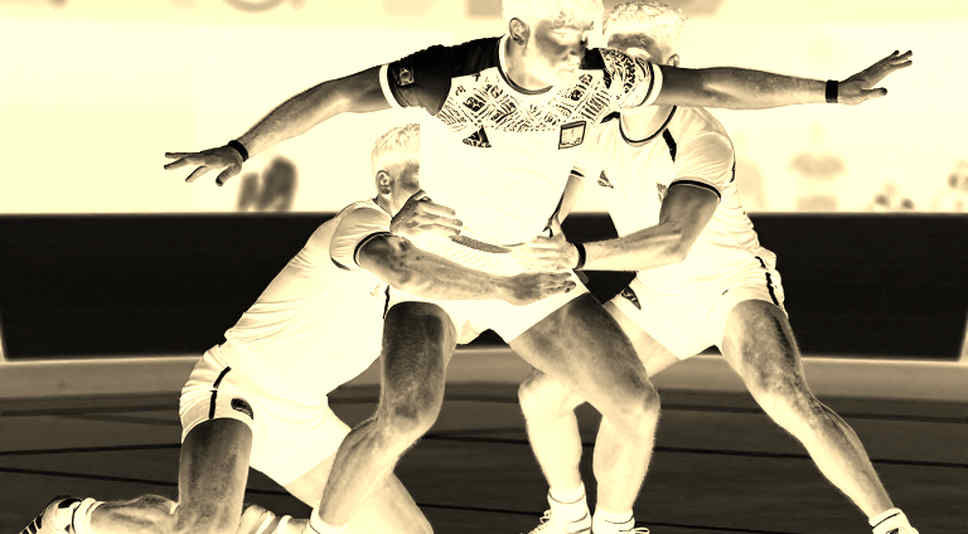
The machinery of the sport needs holding in mind, because every conclusion returns to it. The raider enters the opponent's half chanting kabaddi-kabaddi; if the cant breaks the raid is void, which makes not-inhaling harder than beating a defender. The defending side scores by stopping the raider inside its own half — a tackle. When an entire side is dismissed, an All Out, the opponent takes two points and the routed team returns with all seven players — a full reset. A tackle made with three or fewer defenders on court is a Super Tackle, worth two. Two consecutive scoreless raids turn the third into a do-or-die raid; produce nothing there and the raider himself is out.
Those five mechanisms make kabaddi a game where attack and defence change weather within the same over, and where one error is invoiced during the next raid. India entered Group A as defending champions; the Bangladesh fixture was the first step of a title defence, and the Iran fixture is its true measuring stick. Per Khel Now's match report, Iran is described as formidable — a small editoral allowance, and in analytical terms a large signal.
My own position here is awkward. Born in Bangladesh, working from a Pakistani desk, educated and employed for years in Hangzhou, I once wrote a feature on Bangladeshi women's kabaddi titled after a hibernation waking up. That same team is now walking off a scoreboard defeat. This piece is not interested in coiled patriotism. It is interested in the arithmetic the court produced, because that arithmetic decides whether India can hold gold.
The core: a raid's real clock runs in breath, not seconds
The rulebook sets a thirty-second ceiling on a raid. To the raider on the mat, thirty seconds is not the operative number, because the throat is not guaranteed to run for thirty seconds. Sustaining the cant requires continuous phonation, and continuous phonation disrupts the ordinary rhythm of breathing. Among team contact sports, kabaddi may be the only one whose written time limit for the offence is measured in seconds while its enforced limit is measured in lungs.
If that holds, eleven bonus points are not merely a skill claim — they are a statement about a breath budget. A side that repeatedly walks into a packed six- or seven-man defence and crosses the deep line is announcing that its raiders can hold the chant for a few extra seconds and rotate their axis out of contact on the other side. Eleven of forty-two points, roughly twenty-six per cent, belongs in that reading.
This is where the match's sharpest and least discussed detail sits. The report notes India made it difficult for Bangladesh to reach the bonus line. The same rule was behaving differently for two teams — an open door on one side, a wall on the other. India's raiders were collecting points deep in the territory Bangladesh's raiders could not even reach.
In kabaddi, that is the footprint of the most expensive and most invisible faculty: breath control. When a defence holds a high line — defenders pressing near the corners, meeting the raider early — the raider must either raid deeper and accept risk or retreat empty. An Empty Raid is not merely a failed attempt; it is breath capital spent for nothing. Two in a row turn the third into do-or-die, where a mistake removes the raider himself.
That chain is kabaddi's real punishment system: failure does not only subtract points, it hands the next raider less freedom. The bonus line is the one tool that breaks the chain, because crossing it pays without requiring a tackle. India's eleven bonus points were therefore not decoration — they were a chain-breaker.
Inside the forty-two: an All Out ledger
Decomposed, India's forty-two was eleven bonus points, four All Out points — meaning two separate All Outs — and roughly twenty-seven points from touches and tackles. Bangladesh's twenty-one was five bonus points, one Super Tackle, and around fourteen from touches and tackles. Dry numbers, but arranged they form a picture.
First, India's scoring never rested on one shoulder. Sanju Devi led the offence; Sonali Shingate, captain Pushpa Rana and Pooja, whose signature is the quick hand touch, all contributed. That matters enormously in kabaddi, because a side whose score stalls when one raider is contained hands the opposing defensive plan a simple job.
Second, the All Out is kabaddi's strangest economics: the punishment carries its own pardon. Dismissing all seven opponents earns two points — and returns those seven bodies to the mat. India put Bangladesh through that twice, and twice Bangladesh came back a fresh team. A 42–21 margin is therefore not a straight line; it is a mound resting on two large resets. Kabaddi differs here from football or cricket at the root: the safest way to hold a lead is not to obliterate the opponent but to keep them inside contact while grinding bonus and tackle points. India did both.
Third, the Super Tackle deserves its own shelf. Stopping a raider with three or fewer defenders on court means Bangladesh were short-handed at that moment and still made the stop. Nobody conceded it; it was a decision taken on the mat, priced at two points if it worked and open space behind if it did not. The quietest piece of courage in the match sat exactly there.
Defence: kabaddi's most valuable, least written labour
Manisha Kumari appears in the report for a specific reason: her effectiveness from the left cover. Corner and cover work in kabaddi is a separate trade — holding a three-man chain, steering the raider inward, killing points without ever being visible on a highlight. Fans remember touch points and Super Tackles; the person standing at left cover never gets a line on the scoreboard.
A professional discomfort follows.
Kabaddi's most invisible labour is defensive labour, and its statistics are the most inadequate. This report contains team totals, bonus share, All Out and Super Tackle splits — but no tackle-point breakdown, no successful raid percentage, no named statistical source. What does that mean? We can say India played well. We cannot say how India's defensive system functioned, or how much of Bangladesh's attack lived on one person's shoulders. The first lesson of my kinesiology training was that what is not measured does not improve. In kabaddi, what is not measured is defence.
One conclusion survives at medium confidence: India chose a proactive, risk-tolerant defence rather than an absorb-and-counter shell. Their defence denied Bangladesh the bonus line, which indicates a high line that returned raiders early and short of breath. Against stronger opposition, that choice carries a deferred cost — one missed tackle without cover is two or three points.
Sraboni Mollick: the weight of one raider
Bangladesh's scoreboard is written almost entirely in one name — captain Sraboni Mollick. The report is explicit that she kept her side on the board and kept the raiding line moving.
A fair accounting is required here. Mollick's raids were coming against the most organised defensive unit in the sport, on a high line, on short breath, frequently alone. When an Indian raider faces a comparable line, the cost is a different kind of cost. So compare costs, not essences: India's bonus points were added on a battery with three more comparable raiders waiting behind, while Bangladesh's points came out of one person's borrowing account. That difference is structural, not personal.
Single-raider dependence is the most dangerous structure in kabaddi, because the opponent always has one easy answer: contain the individual and the team stops. Against India, executing that containment forces Bangladesh to spend more defensive breath, and their breath reserves are thinner. Across two twenty-minute halves, that is severe.
The contrarian view: what the scoreline shows, and what it withholds
Here journalism and analysis take different roads. A 42–21 result was the expected result, so it cannot be read for deep meaning. Its real information is not in the numbers but in the timing.
The report notes the gap narrowed with five minutes remaining before Sanju Devi's raids restored a sizeable advantage. In a twenty-one-point match, those five minutes were the only passage in which the game behaved like kabaddi. Precisely for that reason they are the most valuable data — and the most ambiguous.
Two readings are possible, and this match cannot settle which is true.
One: fatigue. Two twenty-minute halves, two or three ground contacts per minute across forty minutes, the first fixture of a long tournament — at the close, reaction speed and decision quality decline together. In kinesiology's language, the anaerobic ceiling draws its line exactly there.
Two: deliberate load-shedding. With a twenty-point cushion, smart teams reduce risk in the last five minutes, avoid handing a new raider a do-or-die, and stop chasing contact.
Which reading is correct will be priced on 23 September against Iran — because next time the opponent will have the capacity to convert a narrowed lead into something final. A weak opponent flattered this pattern once. If the same five minutes return against Iran, they stop being encouraging and start being expensive.
One more note. Kabaddi coverage shows numbers because numbers are easy to show. Defence, strength and conditioning, physio management, travel schedules, food and sleep away from home — none of that lights up a scoreboard, and all of it decides outcomes. This report contains not a single line about injury. Kabaddi is a high-contact sport; knee, ankle, shoulder and elbow injuries are the rule rather than the exception. Injury news travels at its own speed, and often arrives late in whatever order suits the team. That gap in reporting produces a great deal of avoidable pain later in a tournament.
The competitive landscape: an India–Iran duopoly and the tiers beneath it
Women's kabaddi internationally is close to unipolar, but not quite. India sit at the top, Iran are the only standing challenger, and Bangladesh, Thailand and Chinese Taipei occupy the catch-up tier. If Iran and India meet in group play, that is effectively the gold-medal match staged early; whatever the result, the final's expectation will be set there.
The cause of this structure is institutional, not personal. India's women have a real profession — job reservations for athletes in railways, police and the armed forces, national awards, state training infrastructure. Iran's wrestling and weightlifting heritage has produced a specific kind of body and discipline that translates into kabaddi. Bangladesh has kabaddi as its national sport, a wide base and a thin professional structure for women.
The result is a wide but shallow pyramid: participation is abundant, the funnel to the elite is narrow. The Bangladesh side that scored twenty-one points can pressure anyone in patches, but cannot hold that pressure across forty minutes.
A larger gap surfaced while watching. Men's kabaddi has the Pro Kabaddi League. There is no women's equivalent. A woman's professional pathway therefore largely terminates at the national team, and the Asian Games medal sets her financial and social value. The entire women's game's worth hangs on a single event, uncushioned — one bad cycle can stop a great deal.
In that light the Asian Games is not only a competition but an economy. India's opportunity to defend a title is, for everyone else, a model, a proof, and potential funding. That makes 23 September consequential well beyond the mat.
Lessons from an empty stand: how silence becomes part of the account
At the 2026 Chinese national championships in Shaoxing I covered a stadium with no spectators. Xie Wenjun won the 110m hurdles in 13.24 and said it felt like training. The empty stadium taught me that silence is also a crowd — invisible, but weighted.
Did Bangladesh have anyone behind the camera here? The report does not say. That absence is not a failure of journalism so much as a signal: this match landed more in result feeds than in front of eyes. An athlete's career is built in two places — a training hall and a stand. When the second is empty, nobody takes responsibility for the first.
Counter-argument: how wrong is the conventional read?
A twenty-one-point win invites the assumption that India are in superb shape. Not incorrect — but the number is not the real evidence.
A one-sided match yields less information, not more, because there is no reaction, no pressure, and no revenge. India were never tested, never contained, never pushed to the end of their strength. What we learned is not India's ceiling but India's preferences: deep bonus-driven raiding over contact-heavy attack, a high defensive line, exploitation of reset economics.
Second, the largest gap is not in the numbers but around them. Kabaddi reporting often stops at scorecard totals — how many points, who scored. That leaves us without India's raid-break percentage, their Super Tackle count, or what changed on the tackle line in the final five minutes. Without knowing which decision rests on which data, analysis grows overconfident.
I hold the breath-budget thesis at medium confidence, and I want readers to hold it the same way. The figures I am using — eleven bonus points, two All Outs, the late narrowing — come from a match report without a named statistical source. Until detailed tackle points and raid-success figures appear, the bonus-line breath thesis remains a reasoned inference, not proof. The distinction matters, because manufactured certainty is kabaddi coverage's fastest-spreading disease.
One thing can be said firmly: the biggest warning in this match was not the 42 or the 21 but the final five minutes — and the best news sits in the same place, because when India needed Sanju Devi, she came and restored the margin. That kind of clutch capacity is the scarcest currency in a major tournament.
The personal root
When I wrote in 2026 about Kylian Mbappe's 36.2 km/h at the Russia World Cup, my underlying question was how acceleration converts into a career. Kabaddi asks a smaller version of the same question: how do five steps past the bonus line become a team's strategy?
The piece I wrote around 9.83 seconds asked what a fast time carries with it — a body's history and the question of safety. So does kabaddi. Inside eleven bonus points sit breath, training, medicine and rest, and outside that chain sits the risk carried by the person doing the work.
I hold one deliberate limit. I am a spectator and a reporter; I am not inside the lives of the women standing on that mat. So when I say breath budget, I mean mechanism, not proclamation. Four numbers would convert it into measurable analysis: raid duration, deep-entry count, empty-raid count, and tackle headings in the final five minutes. Publish those and women's kabaddi analysis changes entirely.
The takeaway: four keys for 23 September
Four wires are worth watching before the Iran fixture, and none of them appear on an ordinary scorecard.
One: bonus-line conversion. How often can India cross the deep line against Iran? If the rate falls away from twenty-six per cent, India's primary weapon is failing, and with it the chain-breaker.
Two: the empty-raid count. Two or three consecutive empty raids in the first half would put do-or-die pressure on India's shoulders in a way Bangladesh never could. India's greatest asset is raider freedom — time, bonus access, options. Let that run dry and the scoreline dries with it.
Three: the final five minutes. Will India play safe, avoiding contact with a cushion, or reassert authority as they did here? If the lead narrows again, it is fatigue, not tactics.
Four: defensive data. How often do Manisha Kumari and the covers beside her end up in Super Tackle situations against Iran? That number decides whether India's high line is genuine courage or a calculation that only works against weaker sides.
Beyond those four sits a larger question. The Asian Games will end, medals will be distributed, and then what exists for women's kabaddi players? Men have a year-round league, salaries, sponsors, public identity. Women do not. Until those two rooms draw different current, every Asian Games medal will be a single window with the rest of the house dark.
India won this match 42–21, and won it the way it should be won: pressure in defence, scoring spread across the attack, courage at the bonus line. But on this night the person who worked hardest may not be findable in the scorecard on 23 September. And the person who played most alone — Sraboni Mollick — will also be far from the gold arithmetic, though anyone inside kabaddi knows that each time she escaped India's defence, it was a small gold of its own.
I write about sport because it is where time becomes visible. At the 8:30 whistle on 23 September, that time becomes visible again — a question of a gold ticket for India, a throne for Iran, and an uncomfortable truth for Bangladesh: where breath runs out, strategy begins.